Transformers are important components in electrical systems as they help to convert electrical energy from one circuit to another.
Single phase transformers are a type of transformer that can be used to convert alternating current (AC) voltage from one level to another.
In this post, we will cover what a single-phase transformer is, how it works, and some of the advantages it offers in various applications.
What is a Single Phase Transformer?
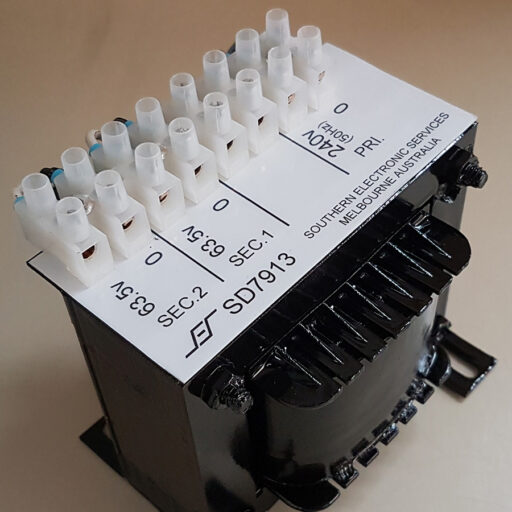
A single-phase electrical transformer uses single-phase power and consists of two main parts: magnetic parts, which consist of the magnetic iron core, and the electric part, which consists of a copper transformer.
The single-phase transformer uses alternating current to create an electromagnetic field. Since the single-phase transformer doesn’t have any moving parts, there aren’t as many energy losses as with transformers that have moving parts. This makes the single phase transformer highly efficient.
However, this type of transformer cannot change frequency, convert single-phase current to three-phase current, stabilise fluctuating line voltage or increase power factor.
Types of Transformers Classified by Electric Network
Based on the electric network used in the transformer, they could be classified as either single-phase transformers or three-phase transformers.
A single-phase transformer typically uses a single-phase ac power supply and has a single winding on both the primary and secondary sides.
A three-phase transformer, on the contrary, uses a three-phase power supply and has three sets of windings.
Faraday’s Law of Electromagnetic Induction
Faraday’s law of electromagnetic induction states that electromotive force (EMF) is generated when a conductor is in a different magnetic field.
Also, electromotive force equals the rate of flux linkages. This means that the EMF generated in a single-phase transformer is p
roportional to the rate of change of flux.
Construction of Single-Phase Transformers
Single-phase transformers have two windings – primary and secondary windings. Both windings are located on a magnetic core which is made out of silicon steel laminations.
This magnetic core is primarily used for the purpose of creating a path for the magnetic flux. Silicon steel is used in order to reduce hysteresis losses, and the laminations help to reduce losses that are a result of localized electrical power induced in a conductor due to varying magnetic fields.
To insulate the laminations from each other, enamel coating is used. There are two main types of single-phase transformer constructions which are the core-type transformer and the shell-type transformer.
The core-type transformer is made up of two vertical legs, also known as limbs and two horizontal sections, also known as yokes. Part of the primary and secondary windings are placed on both limbs to reduce the effects of leakage flux, forming a cylindrical winding.
The shell-type transformer is made up of three limbs in the magnetic circuit. Unlike the core type transformer, the windings are in the middle limp while the other limbs create a low reluctance flux path. The primary and secondary windings are divided into two sections – the low-voltage and high-voltage sections.
How Does a Single-Phase Transformer Work?
A single-phase transformer works by transferring energy from the primary winding to the secondary winding. This is done by creating an electromagnetic field in the transformer core through a process known as mutual inductance.
Typically, the primary windings will connect to an alternating current supplying power, which connects to the coil. When the current flowing through the coil increases, the magnetic field becomes stronger, building magnetic lines of force, which in turn form the magnetic flux. The secondary winding connects the entire system to the magnetic flux.
Applications of Single-Phase Transformers
Single-phase transformers are widely used in various applications. Some use cases of a single-phase transformer include:
- Used in powering lighting and heating devices
- Used in low electricity areas, such as rural areas
- Used in the regulation of home appliances such as television sets and home inverters
Conclusion
Single phase transformers come in different sizes and are used for several purposes based on their make and design. Generally, single-phase transformers are used to reduce or increase output or input voltage levels, isolate circuits and provide electrical isolation.
At Southern Electronics Services, we build single-phase transformers to meet the specific requirements of our clients. With over 40 years of experience in designing transformers, we are confident that we can provide you with a single-phase transformer that meets your needs. Contact us today to find out more!
Get the Latest in Power Transformer Solutions
Get industry insights, product updates, and exclusive offers