
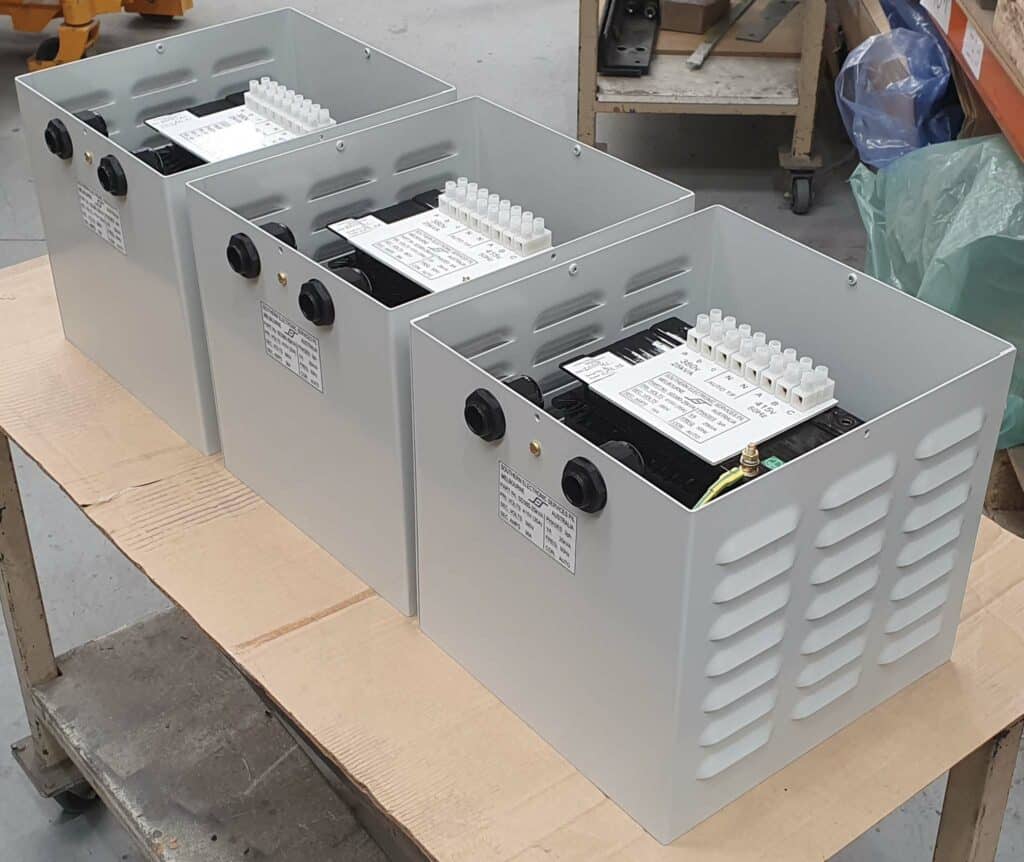
At Southern Electronic Services, we help customers navigate transformer selection with confidence. Whether it’s for power conversion, electrical isolation, or system integration, our team helps you find the solution.
When it comes to 3-phase isolation transformers, understanding winding configurations is essential. It’s not just for function, but for safety, compliance, and long-term reliability.
One of the most misunderstood aspects of 3-phase transformer installations is the different winding vector groups. Another is when and how to correctly link neutral to earth (N-E links). Getting these wrong can lead to system faults, nuisance tripping, or non-compliance.
This guide breaks down the most common LV 3-phase transformer configurations. Discover their vector groups, when to use each, and what every installer needs to know about neutral-earth connections.
Not sure which 3-phase transformer vector group is right for your operations? Speak with the team at Southern Electronic Services today. Get practical guidance based on your operational and compliance requirements.
Delta-Star (Dyn): the Versatile Standard
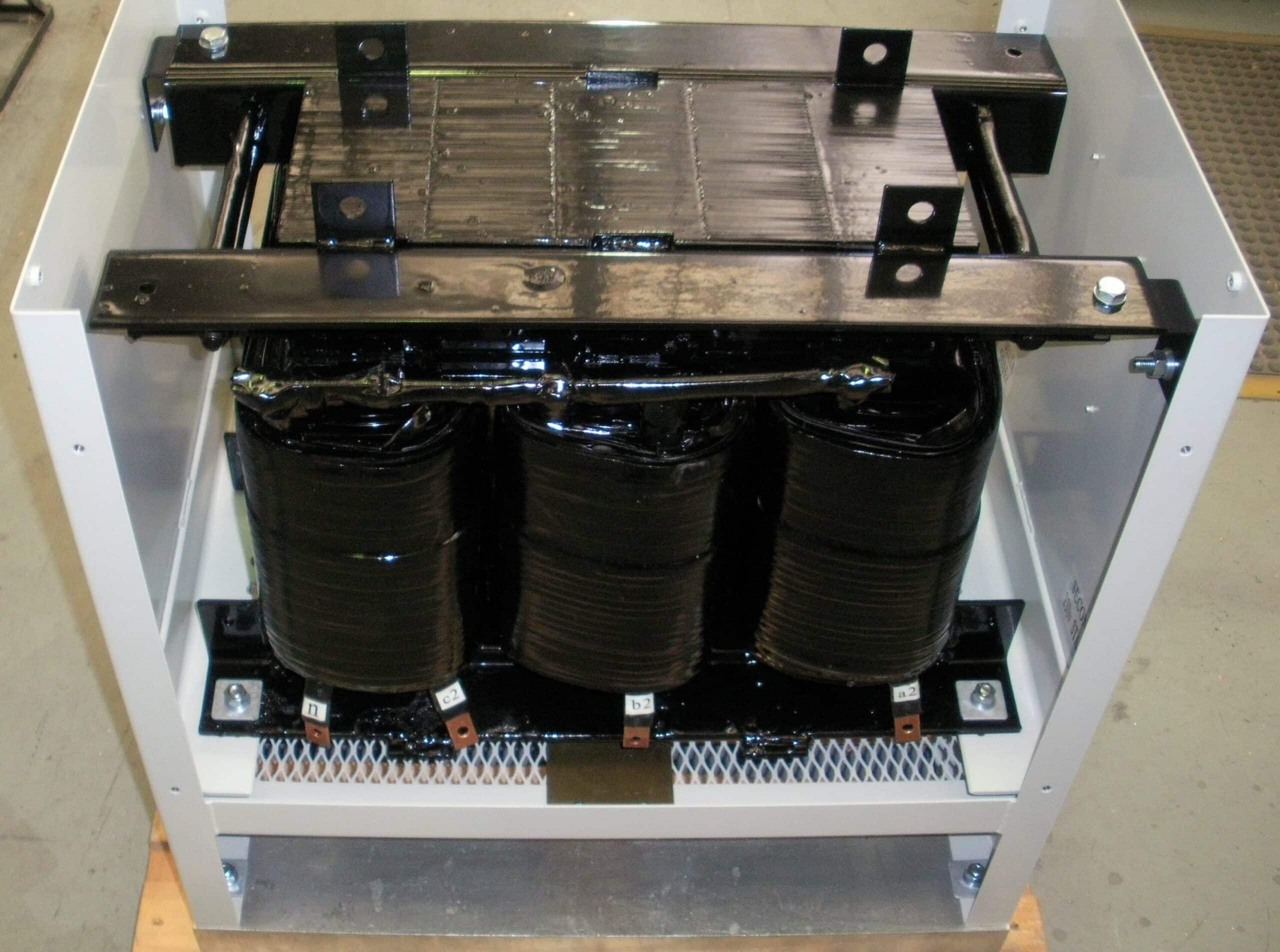
This is the most widely used configuration across commercial and industrial sites. The Delta primary connects to a 3-wire mains supply, and the Star secondary provides an isolated 3-phase and neutral output.
The Delta primary also helps minimise inrush current compared to a Star primary. This improves startup performance and reduces nuisance tripping.
Vector Group
Most SES Dyn transformers are supplied as Dyn11, which defines a Delta primary, Star secondary, and a 30° phase shift between windings. This phasing is ideal for minimising circulating currents and ensuring system compatibility.
When to use
SES Dyn transformers are used when:
- Your load includes both three-phase and single-phase equipment
- You require a neutral reference for protection (e.g., RCDs)
- You need isolation from the supply for compliance or operational safety
Installer tip: Delta Primary and Reduced Inrush
One key advantage of the Delta primary is its ability to reduce inrush current during energisation. The closed Delta winding balances magnetising flux and helps suppress the high current spikes that can occur on start-up.
This is especially helpful when upstream protection is sensitive or the supply is lightly loaded. It also makes Dyn the go-to configuration for dependable performance in industrial environments.
Neutral-Earth Link Note
- If the neutral is in use, it must be bonded to earth, typically at the secondary star point or the main downstream distribution board.
- Never bond the Delta (primary) side to earth. It has no neutral point.
Delta-Delta (Dd0): for Isolated 3-Wire Systems
This configuration provides an isolated 3-phase supply without a neutral. Both windings are Delta-connected. The Dd0 vector group means 0° phase shift between input and output, making it useful when phasing must remain aligned.
When to use
The Dd0 vector group is well-suited where:
- Supplying three-phase-only equipment
- There’s no current or future need for a neutral connection
- Electrical isolation is needed, but a neutral reference is not
Neutral-Earth Link Information
- Do not install an N-E link. There is no neutral point to bond, and doing so introduces safety and compliance risks.
- Always verify that no future neutral loads are planned.
Star-Star (YNyn): for Systems With Dual Neutral Requirements
Both primary and secondary windings are Star-connected, each with its own neutral. This is a less common LV configuration due to its sensitivity to load imbalance.
Vector Group
Typical vector groups include YNyn0 (no phase shift) or YNyn11 (30° phase shift). Which you choose depends on how the system needs to align with other equipment or supplies.
When to use
This vector group is best used when:
- Both the input and output require a neutral
- The installation is balanced and symmetrical
- In engineered systems with specific design requirements
Neutral-Earth Link Advice
- The secondary star point must be bonded to the earth.
- Do not bond the primary neutral. It should be referenced at the source upstream.
Auto Transformers (Step-Down): for Voltage Conversion (not Isolation)
Auto transformers, such as SES’s SD380-25kVA, are used to step down 415 V to 380 V (or similar), without electrical isolation. Because the windings are partially shared, input and output are directly linked.
When to use
Auto transformers are the ideal choice when:
- You need to reduce the voltage for imported or legacy equipment
- Isolation is not required
- You’re looking for a cost and space-efficient solution
Neutral-Earth Link Tips
- Auto transformers share a neutral between the input and output.
- Do not bond the neutral to earth at the transformer, unless it is the origin of a new MEN system (rare).
- Multiple N-E links in shared systems create earth loops, risk RCD issues, and breach compliance.
SES tip
In typical installations, the transformer is supplied from a MEN-protected switchboard. In these cases, leave the neutral floating at the transformer.
Neutral-Earth Link Quick Reference Table
| Configuration | Neutral Available? | N-E Link Required? | Where to Bond? |
| Dyn | Yes (secondary only) | Yes (if neutral used) | Secondary star point or DB |
| Dd0 | No | No | Not applicable |
| YNyn | Yes (both sides) | Yes (secondary only) | Secondary star point |
| Auto Transformers | Shared input/output | Only if the transformer is MEN origin | At DB, not at the transformer |
Get the Right 3-Phase Isolation Transformer With SES
Need a 3-phase isolation transformer configured to your operational requirements?
With nearly 50 years of industry experience, SES designs and manufactures a wide range of isolation transformers. No matter the vector group configuration, we ensure it’s correctly specified for your application.
If you need fast support, we also keep high-grade materials on hand to start production immediately. With Australia-wide delivery, your transformer can be supplied without delay. Speak with the SES team today to get started.
Get the Latest in Power Transformer Solutions
Get industry insights, product updates, and exclusive offers
Any More Questions?
To help us provide you with the best solution to your needs please contact us

Next Post
The Lifecycle of a 3 Phase Transformer
November 13, 2025Other News

Understanding Electrical Protection and 3-Phase Isolation Transformers: What, When and why
In complex industrial environments, effective electrical protection isn’t about using a single device. It’s about applying the right combination of technologies to reduce downtime, maintain compliance, and protect people and equipment. Whether you’re integrating imported machinery or building new infrastructure, knowing what protection is needed, when, and why is essential. This guide explains the key…
The Lifecycle of a 3 Phase Transformer
3-phase transformers are incredibly useful; they allow businesses to distribute power efficiently, safely, and reliably across large or complex systems. By converting voltage levels and balancing electrical loads, they help machinery run smoothly, reduce energy losses, and prevent costly downtime. But how do they work, and what can you expect from their lifecycle? In this…