
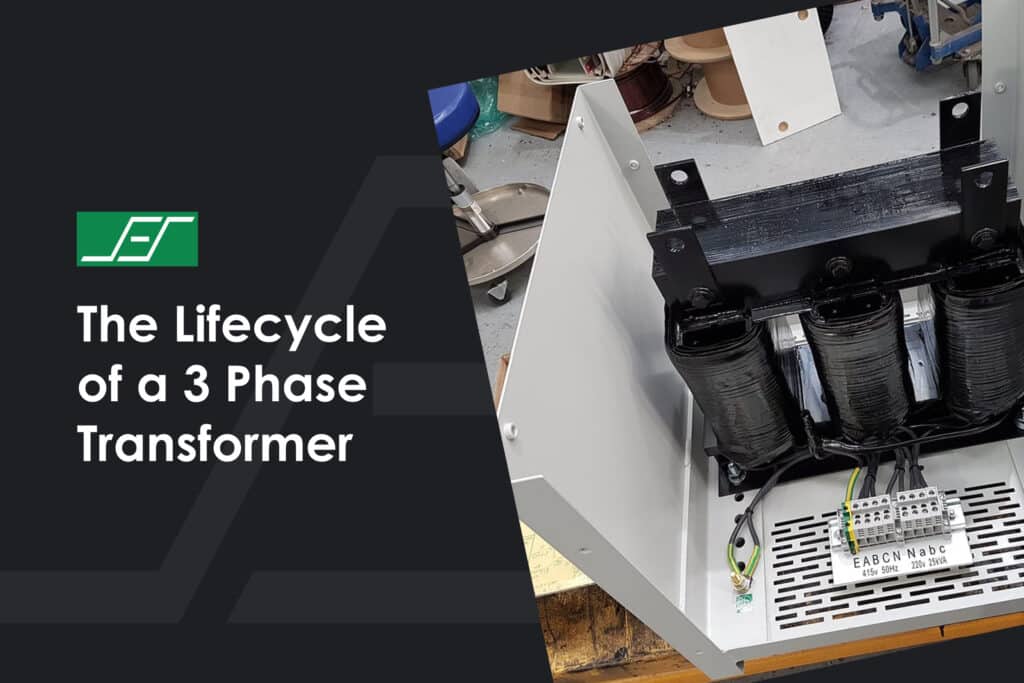
3-phase transformers are incredibly useful; they allow businesses to distribute power efficiently, safely, and reliably across large or complex systems.
By converting voltage levels and balancing electrical loads, they help machinery run smoothly, reduce energy losses, and prevent costly downtime. But how do they work, and what can you expect from their lifecycle?
In this article, we’ll explore how a 3-phase transformer is built, installed, and maintained, and why quality construction makes all the difference in terms of performance and reliability.
Could your operations benefit from a quality 3-phase transformer? Reach out to Southern Electronic Services today. With decades of experience, we design and build transformers you can trust.
Building 3 Phase Transformers
The process of manufacturing 3-phase transformers depends on the type, size, and power ratings required. At Southern Electronic Services (SES), we specialise in the design, construction, and testing of low-voltage (up to 3.3kV) dry-type isolation transformers and autotransformers (commonly known as Step-up or Step-down transformers)
As well as a range of standard transformers, our team can customise solutions to best suit your needs. While certain components and structures may vary depending on the transformer type, the general building process remains the same.
1. Core Construction
First, we build the core of the 3-phase transformer. The core is made of high-grade electrical steel and acts as a base to wrap the windings around. When energised, this core creates an electromagnetic field, which enables to voltage transformation magic to occur within the windings.
2. Windings
Windings receive the input voltage and transfer the output voltage. Depending on the type of transformer, you may have only a single winding or a primary and secondary winding.
Most transformers are wound with either copper or aluminium. While alluminum has some benefits, Southern Electronic Services only uses high-quality enamelled copper for our transformer windings, as it delivers a superior performance and best longevity.
3. Insulation
Finally, we use insulation to separate the electrical currents and reduce the risk of electrical faults. Insulation can be made from a variety of materials, the choice of which, along with how well the transformer is constructed, ultimately determines the longevity/life cycle expectancy of the unit.
At Southern Electronic Services, we keep a large stock of raw materials on hand so that construction of your 3-phase transformer can begin immediately.

Setting up Your 3 Phase Transformer
Once ready, your 3-phase transformer will need to be carefully transported and installed. In this section, we’ll walk you through what to expect.
1. Transporting Your Transformer
At Southern Electronic Services, we can ship our transformers anywhere in Australia or internationally. Once your 3-phase transformer is built, checked and tested for conformance to Australian Standards, we will ship it immediately.
We transport it with protective packaging to keep it secure. Transformers are heavy, and we reinforce our pallets/crates and commonly secure the transformer/enclosure to the pallet itself to ensure a safe journey. This way, no matter how far your transformer has to go, you can trust it will arrive in good condition.
2. Installing Your New Transformer
3-phase transformers need to be carefully installed to ensure the safety of your site and equipment. First, the area should be checked to confirm there’s adequate space, ventilation, and easy access.
Once the site is ready, the electrical systems are isolated/shut down, and the transformer is secured in place, connected, and properly grounded. Finally, it’s inspected and tested to ensure everything operates safely and efficiently.
Southern Electronic Services has Operation & Maintenance Manuals available for your transformer, available upon request. These documents are designed to help you get the most out of your transformer and keep it, your equipment, and your personnel safe.
The Expected Lifespan of a 3-phase Transformer
3-phase transformers usually last around 20 years. At SES, our transformers are all designed to last at least 25 years or more. However, this lifespan may be affected by several different factors, such as:
1. Transformer Capacity & Rating
Transformers are built for a specific purpose – the transformer will have been designed and built with specific ratings – specific voltages, loads, and for specific environments. Operating your transformer outside of these ratings can not only shorten the operating life of the transformer itself, but also put other equipment and people in danger.
Every transformer has a rated capacity. Eg. a 3ph isolation transformer rated at 415V @ 104A (75kVA)
SES designs all of its transformers for continuous operation, meaning that your transformer will run at the rated load 24/7. Assuming it is installed in a suitable environment and is routinely maintained, it will keep running for well over 25 years.
Pushing a transformer beyond its intended capacity may cause overheating, electrical faults, or permanent damage, all of which could significantly reduce its lifespan, let alone the risk of harming other equipment or personnel.
2. Exposure to the Elements
3-phase transformers that are constantly exposed to extreme weather may also have shorter lifespans. Moisture, heat, dust, and corrosive environments can damage materials over time, affecting their overall performance. Try to avoid this by keeping your transformer in a sheltered area.
Ambient temperature is a factor that we used to see largely overlooked in industry, but now with global temperatures rising, people are beginning to specify higher ambient temperatures, as they look to future-proof their assets. Standard transformers are typically designed to operate in 40°C ambient temperatures, which, for most applications, is ample. But when projects such as solar farms, remote energy installations, or other outdoor applications are being built for 35 35-year design life, engineers are now smartly factoring in higher ambient temperatures, 50°C and even above.
3. Regular Maintenance
Transformers are almost maintenance-free. Almost. With no moving parts, there is very little that can go wrong with a transformer, but routine maintenance is still highly recommended every 12 months.
Routine maintenance includes ensuring bolted connections are tight, there is no dust/foreign objects present, particularly on the windings / in obscuring any cooling ducts – all maintenance should be performed with the transformer isolated from any power source.
Every 5 years, a more thorough check is recommended to ensure components, particularly the insulation, are in good order. Once the transformer has been in operation for 20 years or so, consider acquiring yourself a replacement to avoid any unforeseen downtime/risk to your equipment.
Without regular maintenance, 3-phase transformers are less likely to last as long. Leaving minor issues unaddressed can eventually lead to much larger problems, such as system failure.
Regularly inspect your transformers and equipment. Keep your transformer clean and perform repairs as soon as you notice any issues. All of this may help your 3-phase transformer last longer.
Get a Quality 3-Phase Transformer Today
3-phase transformers might seem complex, but with over four decades of experience, Southern Electronic Services is here to make it simple. Whether you’re after 3-phase isolation, step down, or custom transformers, our team is ready to get to work. Reach out to us today and improve your operations with a reliable 3-phase transformer built to last.
Get the Latest in Power Transformer Solutions
Get industry insights, product updates, and exclusive offers
Any More Questions?
To help us provide you with the best solution to your needs please contact us

Next Post
3-Phase Transformer 415V Conversion | 200V, 220V, 380V, 480V
November 13, 2025Other News

Understanding Electrical Protection and 3-Phase Isolation Transformers: What, When and why
In complex industrial environments, effective electrical protection isn’t about using a single device. It’s about applying the right combination of technologies to reduce downtime, maintain compliance, and protect people and equipment. Whether you’re integrating imported machinery or building new infrastructure, knowing what protection is needed, when, and why is essential. This guide explains the key…

Understanding 3-Phase Isolation Transformer Configurations: What, When, and why
At Southern Electronic Services, we help customers navigate transformer selection with confidence. Whether it’s for power conversion, electrical isolation, or system integration, our team helps you find the solution. When it comes to 3-phase isolation transformers, understanding winding configurations is essential. It’s not just for function, but for safety, compliance, and long-term reliability. One of…