
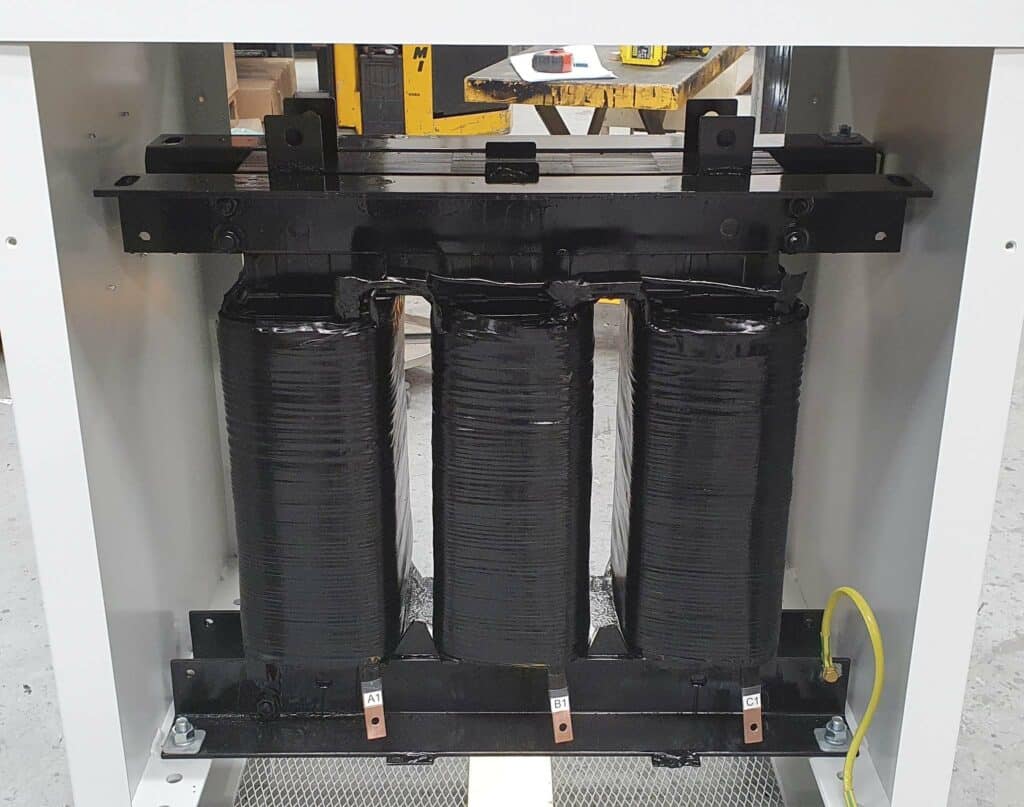
In complex industrial environments, effective electrical protection isn’t about using a single device. It’s about applying the right combination of technologies to reduce downtime, maintain compliance, and protect people and equipment.
Whether you’re integrating imported machinery or building new infrastructure, knowing what protection is needed, when, and why is essential.
This guide explains the key types of electrical protection used in Australian 3-phase systems, and how they work together, including 3-phase isolation transformers, surge protectors, overcurrent devices, and more.
Looking for reliable electrical protection solutions? Reach out to Southern Electronic Services. With decades of industry experience, we provide custom-engineered solutions to suit your application.
1. Electrical Isolation and Voltage Adaptation
Electrical isolation uses a transformer with galvanically separated windings to electrically separate the supply from the load. There is no direct conductive path between primary and secondary.
In many industrial applications, isolation is combined with voltage conversion, such as stepping 415V down to 380V, 220V, or 200V, allowing equipment to operate correctly on Australian 415V mains.
It’s important to note that voltage conversion does not always require isolation. In many facilities, isolation may already be provided upstream. The requirement depends on the site’s protection design and compliance obligations.
When it’s Required
- Operating electrically sensitive equipment where upstream isolation is not provided
- Applications where electrical separation is specified for safety or compliance
- Reducing electrical noise transfer between supply and load
- Implementing floating or centre-tap earthing arrangements
- Adapting non-standard voltages while also requiring galvanic separation
Why it Matters
- Limits fault transfer between supply and load
- Improves system stability in sensitive applications
- Enables correct voltage delivery for non-standard equipment
- Supports compliance with Australian Standards where separation is specified
How SES Supports This
SES designs and manufactures precision-engineered 3-phase isolation transformers and 3-phase step-down auto-transformers tailored for Australian sites.
Whether you’re running CNC machinery from Europe or robotics from Japan, we’ll build a transformer that ensures safe and stable operation on 415V mains.
2. Surge Protection Devices (SPDs)
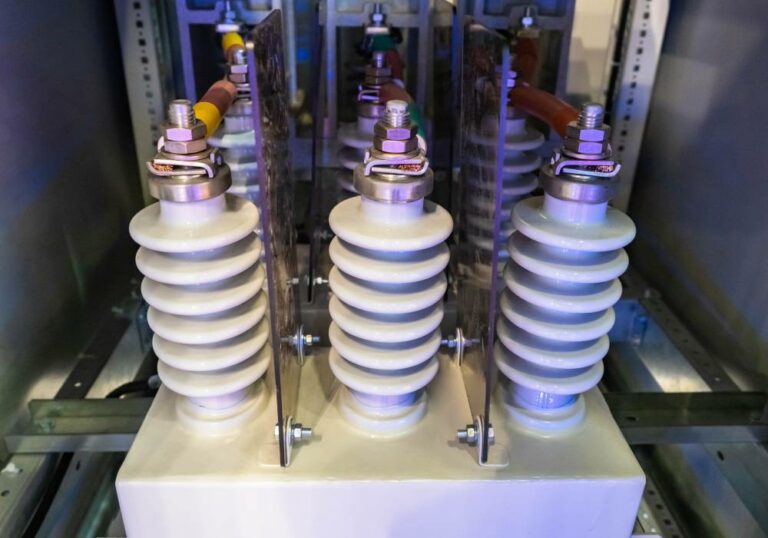
Surge Protection Devices (SPDs) are designed to divert high-energy transient voltages, such as lightning-induced surges or switching events, away from electrical systems.
They are typically installed at the main switchboard or distribution level as part of a broader protection strategy.
SPDs do not continuously regulate voltage. They activate only when a transient overvoltage exceeds their protection threshold.
When it’s Required
- Sites that are exposed to frequent lightning activity.
- Locations with unstable grid connections.
- Compliance with AS/NZS 3000 for sensitive systems or long cable runs.
Why it Matters
- Prevents catastrophic failure of sensitive electronics.
- Reduces the impact of fast transient voltages.
- Provides a first line of defence, especially at the switchboard level.
Protection Limitations
SPDs do not provide isolation, correct voltage mismatches, or manage power quality. They are reactive devices, not continuous protection or conversion solutions, and are used in conjunction with other components.
3. Overcurrent Protection (MCCBs, Fuses)
Overcurrent protection devices, including MCCBs (Moulded Case Circuit Breakers) and fuses, are designed to disconnect a circuit during overload or short circuit conditions.
They are a mandatory component of compliant switchboard and control panel design.
When used with 3-phase transformers, protection must be correctly coordinated with the transformer’s kVA rating, impedance, and inrush characteristics.
When it’s Required
Always.
Every transformer installation requires correctly sized primary protection. In most cases, secondary protection is also required depending on system configuration and downstream distribution design.
Protection devices must be selected based on:
- Transformer full load current (FLC)
- Prospective short circuit current
- Transformer impedance
- Inrush current characteristics
- Installation requirements under AS/NZS standards
Why it Matters
- Prevents conductor damage and fire risk
- Protects the transformer windings from sustained overload
- Ensures safe disconnection under fault conditions
- Maintains compliance with Australian Standards
Incorrectly sized protection can lead to nuisance tripping, or worse, insufficient fault protection.
SES Engineering Insight
Transformer protection is not simply a matter of matching breaker size to kVA.
Inrush current, particularly on LV dry-type isolation transformers, can be significantly higher than full load current during energisation. Protection must be selected to accommodate this without compromising fault protection.
SES can provide recommended primary and secondary protection parameters based on transformer design and application.
Correct coordination improves reliability, reduces downtime, and protects transformer service life.
4. Additional Protection Layers
Depending on your installation, other protective measures may be necessary:
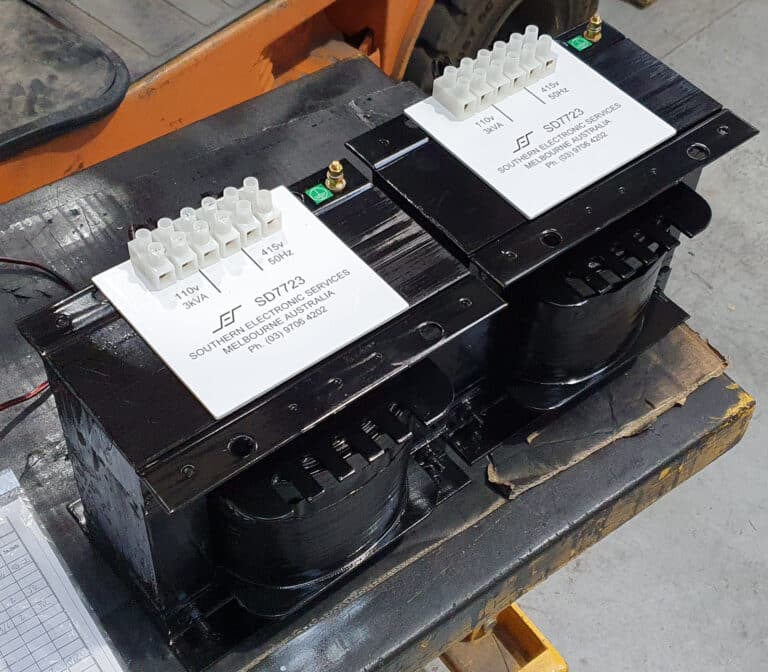
- Thermal Protection: Many SES transformers include thermal switches or temperature monitoring for early warning of overload conditions.
- Harmonic Filtering: In systems with variable-speed drives or nonlinear loads, additional filtering may be required to maintain power quality.
- Earthing and Bonding: A correct earthing strategy is critical when using isolation transformers, particularly for floating or centre-tap grounded systems.
5. Bringing it all Together: Layered Protection
In a well-designed industrial system, protection isn’t just one device; it’s a layered approach:
- Isolation Transformer
Stabilises voltage and electrically separates equipment. - Surge Protector
Absorbs transient spikes. - MCCB/Fuse
Disconnects the circuit in the event of an overload. - Correct Earthing
To maintain safe fault paths. - Thermal and Harmonic Protections
As needed.
Layered Protection in Action
Importing 380V Machinery Into an Australian Facility
A manufacturing site installs German-built equipment rated for 380V. The local supply is 415V.
SES supplies a 3-phase step-down isolation transformer (415V to 380V) to adapt the voltage and provide galvanic isolation. Surge protectors are installed at the switchboard to absorb spikes, and MCCBs sized to transformer specs provide overcurrent protection.
Together, the system operates reliably and complies with Australian standards.
6. Why Local Support Matters
Time-sensitive projects and non-standard voltage requirements demand a fast, informed response. With SES, you’re dealing with a local manufacturer that:
- Understands Australian compliance requirements.
- Builds custom 3-phase transformer solutions to spec.
- Offers fast turnaround and technical support.
- Uses durable, dry-type construction suited to industrial environments.
Partnering with SES ensures your protection solution doesn’t just work; it’s built to last.
Important Notice
The information provided in this article is general in nature and intended for educational purposes only.
Electrical protection requirements vary depending on site conditions, supply characteristics, equipment specifications, and applicable Australian Standards.
All electrical design, installation, and protection coordination should be carried out by appropriately licensed and qualified electrical professionals. Local regulations, AS/NZS standards, and site-specific compliance requirements must always be adhered to.
For application-specific advice, speak with the SES team or consult your electrical engineer before proceeding with installation.
Frequently Asked Electrical Protection Questions
1. Do surge protection devices provide isolation?
No. They only operate during transient events and do not separate supply from load.
2. Is a 3-phase isolation transformer enough to protect my equipment?
It improves power quality and adds safety, but for full protection, it should be used alongside SPDs and overcurrent devices.
3. Can SES help with transformer protection design?
Yes. We can assist with fuse sizing, switchgear options, and transformer specifications tailored to your load and environment.
4. What voltages can SES transformers handle?
We custom-build transformers for common conversions such as 415V to 380V, 220V, or 200V, depending on your machinery.
5. Do I need both surge protection and isolation?
In most industrial installations, yes. Isolation ensures continuous performance and compliance; surge protection handles unpredictable transients.
Need Advice on the Right Protection Setup?
Every site is different. Our team works with electrical contractors, project managers, and engineers to design 3-phase isolation transformer systems that ensure safety, reliability, and compliance.
Whether you’re integrating imported machinery, upgrading existing infrastructure, or planning a new installation, our team can provide informed, tailored guidance. Contact SES for expert advice or a quote on your next transformer project today.
Get the Latest in Power Transformer Solutions
Get industry insights, product updates, and exclusive offers
Any More Questions?
To help us provide you with the best solution to your needs please contact us

Next Post
Understanding 3-Phase Isolation Transformer Configurations: What, When, and why
January 21, 2026Other News

Understanding 3-Phase Isolation Transformer Configurations: What, When, and why
At Southern Electronic Services, we help customers navigate transformer selection with confidence. Whether it’s for power conversion, electrical isolation, or system integration, our team helps you find the solution. When it comes to 3-phase isolation transformers, understanding winding configurations is essential. It’s not just for function, but for safety, compliance, and long-term reliability. One of…
The Lifecycle of a 3 Phase Transformer
3-phase transformers are incredibly useful; they allow businesses to distribute power efficiently, safely, and reliably across large or complex systems. By converting voltage levels and balancing electrical loads, they help machinery run smoothly, reduce energy losses, and prevent costly downtime. But how do they work, and what can you expect from their lifecycle? In this…